
A Dictionary of Dental Terms (tm)
Table Of Contents
We have assembled a factual list of common dental and orthodontic terms. When browsing our website you will see many of these terms used. This dental dictionary is updated often, so be sure to check back for the latest dental terms and definitions.
Definitions Of General Dental Terms
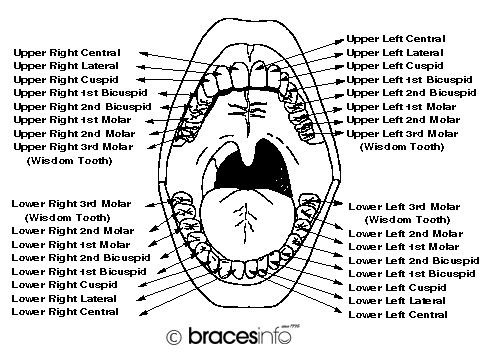
Names Of Individual teeth
Palmer’s Notation
Palmer’s notation is a widely used method to designate individual teeth. In Palmer’s notation, your mouth is divided into four parts called quadrants, that is the upper left quadrant, the upper right quadrant, the lower left quadrant, and the lower right quadrant as illustrated in the figure on the right. Then each individual tooth in the quadrant is given a name. For example the two upper and two lower teeth at the center of your mouth are called central’s. One then combines the names of the quadrant and the tooth to come up with a Palmer’s notation. For example, the central on the upper right side of your mouth is called an upper right central.
The remaining teeth are designated as follows:
| Central | The two upper and two lower teeth in the very center of your mouth. More |
|---|---|
| Lateral | The teeth just adjacent to the centrals. |
| Cuspid | The pointy teeth just behind the laterals. These teeth have one cuspal (or point). Cuspids are also called canines. |
| First Bicuspid | The teeth just behind the cuspids. These teeth have two cuspals (or points) |
| Second Bicuspid | The teeth just behind the first bicuspids. These teeth also have two cuspals (or points). |
| First Molar | The teeth just behind the second bicuspids. These teeth have a level surface with four cuspals. |
| Second Molar | The teeth just behind the first. These teeth also have a level surface with four cuspals. |
| Third Molar | The teeth just behind the second molars. These teeth also have a level surface with four cuspals. |
| Incisor | Another name for the centrals and laterals |
| Canine | Another name for the cuspids |
| 6 year molar | Another name for your first molar |
| 12 year molar | Another name for your second molar |
| Wisdom Tooth | Another name for the third molar |
| Anterior Teeth | Your centrals, laterals, and cuspids. These are the teeth in the front of your mouth |
| Posterior Teeth | Your bicuspids and molars. These are the teeth in the back of your mouth. |
| Deciduous Teeth | Your primary, or “baby teeth” |
| Primary teeth | The first set of teeth which come in. Primary teeth are also called “baby teeth” or deciduous teeth. |
| Secondary Teeth | Your permenant teeth, i.e. the second group of teeth to come in. |
| Quadrants | The four parts of your mouth, that is the upper left, the upper right, the lower left, and the lower right. |
| Numerical notation for teeth | The numerical notation for teeth is an alternate to Palmer’s notation. In this notation, the centrals are designated as 1’s, the laterals as 2’s, the cuspids as 3’s, the first bicuspids as 4’s, the seond bicuspid’s as 5’s, etc. |
| Universal numerical notation for teeth | The universal numerical notation is an alternative numerical notation for teeth. In this notation, your upper right third molar is designated as tooth#1, and then you number each tooth sequentially moving right to left and down across your mouth. |
Parts Of A Tooth And Your Mouth
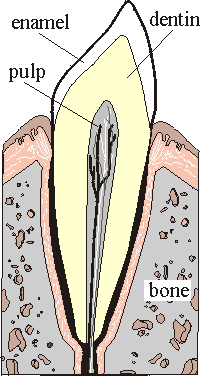
| Alveolus | A opening in your jaw-bone in which a tooth is attached. |
|---|---|
| Apex | The very bottom of the root of your tooth |
| Buccal | The tooth surface which is next to your cheeks. Usually only posterior teeth touch your cheeks, so people usually use the term “buccal” only when talking about your back teeth. |
| Cementum | A bony substance covering the root of a tooth. |
| Crown | The part of your tooth above your gum. |
| Cuspal | The chewing or tearing points of the cuspids, bicuspids, and molars. |
| Dentin | The calcium part of a tooth below the enamel containing the pulp chamber and root canals. |
| Enamel | A hard ceramic which covers the exposed part of your teeth. |
| Frenum | Small pieces of pink colored skin that attach your lips, cheeks and tongue to your mouth. Examples include the piece of skin under your tounge which sticks out when you pick up your tongue, and the piece of skin which sticks out when you pull out your lips. |
| Gingivae | Another name for your gums |
| Gums | The pink areas around your teeth |
| Pulp | The soft inner structure of a tooth, consisting of nerve and blood vessels |
| Pulp Chamber | The very inner part of your tooth containing nerve cells and blood vessels. |
| Pulp canal | Another name for the pulp chamber |
| Root | The part of your tooth in your gums |
Other dental terms
| Abutment | The teeth on either side of a missing tooth. |
|---|---|
| Amalgam | A silver/mercury mixture which is used for fillings. |
| Anatomy | 1)The arangement of the bones in your skeleton 2) The study of the arrangement of the bones in your skeleton. |
| Antiseptic | A chemical agent which can be applied to living tissues to destroy germs. |
| Anesthetic | A drug which a doctor or dentist uses to put you, your mouth, or some other part of your body asleep so you do not feel any pain during dental or medical procedures. |
| Anterior | An adjective used to describe things pertaining to your your Centrals, laterals and cuspids (your front teeth). |
| Arch | Collectively, either the teeth or the basal bone of either jaw. |
| Articulator | A special holder for models of your teeth. The articulator holds the models in the same alignment as your jaw so the orthodontist can look carefully at your bite. |
| Asepsis | The avoidance of potentially pathogenic microorganism. In practice,it refers to those techniques which aims to exclude all microorganisms. |
| Aspirator | A tube like a straw which the dentist puts in your mouth to suck up all the saliva. |
| Aspiration | Removal of fluids from your mouth with an aspirator. |
| Bruxism | Clenching or grinding of your teeth especially at night. |
| Calculus | A hard deposit that forms when you do not brush your teeth so the plaque hardens. Calculus is also known as tartar. |
| Caries | Another name for a cavities (tooth decay) |
| Cavity | A small hole in one of your teeth caused by tooth decay. |
| Cross contamination | Passing bacteria, viruses or AIDS indirectly from one patient to another through the use of improper sterilization procedures, unclean instruments, or “recycling” of orthodontic products. |
| Crown | 1) An artifacial tooth, 2) an artificial replacement for the covering on a tooth. |
| Curettage | A periodontal procedure where your gums are scraped to remove bacteria. |
| Decalcification | The loss of calcium from your teeth. This weakens your teeth and makes them more succeptable to decay. |
| Denture | A synthetic replacment for all of your teeth in either your upper or your lower jaw. |
| Diagnosis | the process of identifying the nature of a disorder. |
| Direct contamination | Direct contact with impurities or germs. (for example by a Patient sneezing on the assistant.) |
| Disinfection | A cleaning process which destroys of most microorganism, but not highly resistant forms such as bacterial and mycotic spores or the AIDS virus. |
| Disinfectant | A chemical agent which is applied onto inanimate surfaces, for example chairs, to destroy germs. |
| Disposable materials | materials intended for one use and discarded. (e.g.: Gloves, paper gowns, cotton rolls, sponges, etc.) |
| Distal | Behind towards the back of the mouth. For example you might say that the first bicuspid is distal to the cuspid. |
| Edentulous | Someone is said to be edentulous whene all of their teeth are missing from either their upper or lower jaw. |
| Endodontist (Endo) | A dentist who specializes in root canals and the treatment of diseases or injuries that affect the root tips or nerves in your teeth. |
| Erupt, Eruption | When a new tooth comes in, the tooth is said to erupt when the tooth breaks through the surface of your gums, so you can see the tooth in your mouth. |
| Exfoliate | to fall out. (Your Deciduous teeth exfoliate and permanent teeth erupt into the space.) |
| Extraoral | Outside of your mouth. For example, neck pads are sait to be extra oral products since they go outside of your mouth. |
| Filtrum | the dimple or indentation under the nose directly above the upper lip. |
| Fluoride | A chemical solution or gel which you put on your teeth. The flouride hardens your teeth and prevents tooth decay. |
| Gingival hypertrophy | The abnormal enlargement of the gingiva surrounding the teeth caused by poor oral hygiene. |
| Gingivitis | The inflammation of your gums caused by improper brushing. The first sign of periodontal (gum) disease. |
| Impacted tooth | An unerupted tooth that somehow has gotten stuck and cannot come in. |
| Implant | A replacement for one of your missing teeth. The implant is different than a bridge in that the implant is permenantly attached into your jaw. |
| Incisal | The biting edge of your centrals and laterals. |
| Interproximal | the space between adjacent teeth |
| Intraoral | Inside your mouth. For example, orthodontic rubber bands are called intraoral products since the rubber bands are designed to go in your mouth. |
| Irrigation | the technique of using a solution to wash out your mouth and to flush debris. |
| Labial | The tooth surface next to your lips or things mounted on the tooth surfaces next to your lips. |
| Lingual | The tooth surface next to your tongue or things mounted on the tooth surfaces next to your tongue. |
| Mandible | Your lower jaw |
| Mandibular | Pertaining to your lower jaw |
| Masticate | To chew your food and mix the food with saliva |
| Maxilla | Your upper jaw |
| Maxillary | Pertaining to your upper jaw |
| Mesial | Forward or front. For example your cuspid is mesial to you bicuspid. The mesial surface of your bicuspid is the part of the bicuspid closest to your cuspid. |
| Midline | A plane through the very center of your mouth perpendicular to your nose. |
| Mixed dentition | The situation when both deciduous and permanent teeth are present. |
| Occlusal | the chewing or grinding surface of the bicuspid and molar teeth. |
| Occlusal plane | the imaginary surface on which upper and lower teeth meet. |
| Occlusal radiograph | the only x-ray that is taken without a precision(tm) x-ray holder. The x-ray film for this procedure is shaped like a large oatmeal cookie. You are asked to bite on the x-ray film and the top of the x-ray machine is positioned over your nose for a maxillary occlusal x-ray or under your chin for a mandibular occlusal film. The x- ray shows the whole arch. |
| Oral | pertaining to the mouth. |
| Osteoblasts | Cells which aid the growth and development of teeth and bones. |
| Osteoclasts | Cells which help create the sockets in bones. For example osteoclasps create the openings in your jaw bone to hold your teeth. |
| Pathogens | disease producing organisms that can exist in many different places. (e.g.: Air, dust, counter top surfaces, the body, etc.) |
| Pathology | the study of abnormal (diseased) tissue conditions. |
| Pedodontist (Pedo) | A dentist who specializes in the treatment of children’s teeth. |
| Periapical | x-ray of individual teeth or groups of teeth. |
| Periodontist (Perio) | A dentist who specializes in the treatment of diseases of your gums. |
| Plaque | is a colorless, odorless, sticky substance containing acids and bacteria that causes tooth decay. |
| Periodontal | Pertaining to your gums. For example periodontal desiese is gum disease. |
| Periodontist | A dentist who specializes in the treatment of gum disease. |
| Posterior | An adjective used to describe things pertaining to the back of your mouth or your back teeth. |
| Prophylaxis | Cleaning your teeth |
| Prosthodontist | A dentist who specializes in the replacement of missing teeth. |
| Proximal | Refers to the surfaces of teeth that touch the next tooth; the space between adjacent teeth is the interproximal space. |
| Radiograph | Another name for an x-ray |
| Root canal | A procedure where the nerve of a heavily decayed tooth is removed from the tooth replaced with a filling material |
| Sagittal plane | The longitudinal vertical plane that divides the mouth into two halves (left and right.) |
| Sanitization | A cleaning process which reduces germs to a “safe” level. |
| Space maintainer | A gadget used to maintain a space in your mouth. You would use a space maintainer when you lose one of your baby teeth. The space maintainer will keep a space in your mouth until a permenant tooth comes in to fill the space. |
| Sterilization | A process where a medical material is treated to remove all possible germs and other forms of life |
| Supernumerary teeth | Some people have extra teeth. These are called “supernumerary teeth”. |
| Tartar | Another name for calculus |
| TMJ | An abreviation for the “temporomandibular joint” The “temporomandibular joint” is the joint where your lower jaw connects to your skull. |
| Treatment card | a sheet of paper or special index card used to record your treatment progress. |
Definitions Of Orthodontic Terms
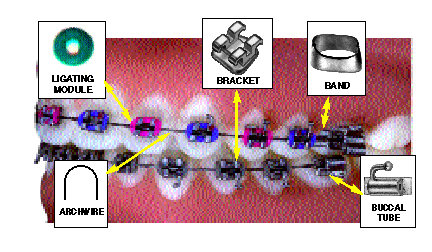
Parts Of Your Braces
| Appliance | Anything the orthodontist attaches to your teeth to move your teeth or to change the shape of your jaw |
|---|---|
| Arch Wire | A metal wire which is attached to your brackets to move your teeth. |
| Band | a metal ring that is usually placed on you teeth to hold on parts of your braces |
| Bracket | A metal or ceramic part that is glued onto a tooth and serves as a means of fastening the arch wire. |
| Breakaway | A breakaway is a small plastic piece with an internal spring which is used to provide force on a facebow. |
| Buccal tube | A small metal part that is welded on the ourside of a molar bank. The buccal tube contains a slots to hold archwires, lip bumpers, facebows and other things your orthodontist uses to move your teeth. |
| Chain, Orthodontic Chain | A stretchable plastic chain used to hold archwires into brackets and to moke teeth. |
| Facebow, Headgear | Facebows are wire apparatus used to move your upper molars back in your mouth which creates room for crowded or protrusive anterior teeth. Generally, the facebow consists of two metal parts which have been attached together. The inner part is shaped like a horseshoe. This part goes in your mouth and is connected to your buccal tubes. The outer part has two curves. The curves go around your face, and connect to the breakaways or high pull headgear. To properly use the product, the inner bow needs to be inserted into your buccal tubes. An elastic neck band is placed around the back of the neck while the triangular cast offs on both sides of neck band are attached to the outer bow of the headgear. Completing the apparatus is a plastic safety strap that is placed over the neck band and onto the outer bow of the headgear. |
| Ligating module | A small plastic piece, shaped like a donut, which is used to hold the arch wires in the brackets on your teeth. |
| Lip bumper | A lip bumper is used to push the molars on your lower jaw back to create more space for other teeth. The lip bumper conists of an arch wire which is attached to a molded piece of plastic. You mount the arch wire in the buccal tubes on your lower jaw, and plastic piece rests against your lips. When you eat or talk, you push the plastic piece back which pushes on your molars. That pushes your molars back. |
| Mouthguard | A device that is used to protect your mouth from injury when you are participating in sports. The use of a mouthguard is especially important for orthodontic patients, to prevent injuries. |
| Neck pad | A neckpad is a cloth covered cushion which you wear around your neck when you put on your facebow. Generally, the breakaways are attached to the neckpad to provide force for the facebow. |
| Palatal Expander | A device used to make your jaw wider |
| Retainer | A gadget that the orthodontist gives you to wear after the orthodntist removes your braces. The retainer attaches to your upper teeth and holds them in the correct position. You wear the retainer at night to make sure that none of your teeth move while your jaw hardens and your teeth get strongly attached to your jaw. |
| Safety Strap | A plastic strap which prevents a facebow from coming loose and hurting you. |
| Seperator | A plastic or metal part which the orthodontist uses to create space between your teeth for bands. |
| Wax | A clear wax used to prevent your braces from irritating your lips when your braces are first put on, or at other times. |
The Orthodontist’s Tools
| Band Remover | A special plier which the orthodontist uses to remove bands from your teeth |
|---|---|
| Bite Stick | A device the orthodontist uses to help put on your bands. The orthodontist puts the band in place, then asks you to bite down on the bite stick to help push the band in place. |
| Cephalometric Viewer | An x-ray viewer |
| Cheek retractors | Small plastic pieces used to draw back your lips and cheeks so the orthodontist can more easily see you teeth and work in your mouth. |
| Curing Light | A special UV light used to help attach brackets to your teeth |
| Distal End Cutter | A special plier used to cut off the ends of your arch wires. |
| Explorer | a hook-like fine pointed instrument used in examining the teeth. |
| Interproximal Stripper | A device used to remove some of the enamel from the spaces between your teeth. The stripper is used to create extra space for crowded teeth. |
| Mathieu Plier | A special plier which locks when it closes so it holds on to small parts. |
| Pin and Ligature Cutter | A special plier use to cur off arch wires, ligatures etc. |
| Scaler | A tool with a curved hook on one end. The orthodontist uses the scaler to remove excess cement, and check for gaps. |
| Twirl On | A device used to help place ligating modules on brackets. |
Orthodontic Procedures
| Acid etch | A procedure where a weak acid smeared on your teeth to ready your teeth for brackets. The acid etch helps your brackets stay on better. |
|---|---|
| Banding | the process of cementing orthodontic bands to your teeth |
| Bonding | the process of attaching brackets to your teeth using a special safe glue |
| Cephalometric X-Rays | An x-ray of the head that shows whether your teeth are aligned properly, and whether they are growing properly. |
| The Consultation | A meeting with your orthodontist where he discusses your treatment plan |
| Debanding | the removal of cemented orthodontic bands. |
| Debonding | The removal of the brackets from your teeth |
| Extraoral photograph | facial photos. |
| Impressions | The first step in making a model of your teeth. You bite into a container filled with algenate, and the algenate hardens to produce a mold of your teeth. |
| Interceptive Orthodontic Treatment | Orthodontic treatment usually done when you are 6-8. The objective of interceptive orthodontic treatment is to expand your palate and make other corrections, so that your later orthodontic treatment goes quicker and is less painful. |
| Ligation | A process where an archwire is attached to the brackets on your teeth. |
| Ligating | An adjective used to describe components used to attach archwires to brackets. For example a ligating module is a small plastic piece that goes over the brackets to hold in your archwires. |
| Panoramic x-ray | An x-ray taken by a machine that rotates around your head to give the orthodontist a picture of your teeth, jaws and other important information. |
| The records appointment | One of the initial appointments with your orthodontist. The orthodontist or his/her assistant takes pictures of you, x-rays, and impressions so that they can figure out what treatment needs to be done. You go into the orthodontist’s office and the orthodontist’s assistant either makes adjustments to the wires in your braces, or changes the wires. |
| Wax bite | A procedure to measure how well your teeth come together. You bite a sheet of wax and leave bitemark in the wax. The orthodontist looks at the bitemarks to see how well your teeth are aligned. |
Dental and orthodontic gadgets and materials not mentioned elsewhere
| Acrylic | A plastic used to false teeth, retainers, and other dental products. Dental acrylic has been tested and thought to be perfectly safe. |
|---|---|
| Algenate | A plaster like compound used to take impressions. It tastes awful, but is safe. |
| Armamentarium | A general term for the dental chairs, lights and equipment used by your dentist or orthodontist. |
| Biomechanics | the relationship between the force you apply to living tissue such as teeth and gums and and how the tissue moves and changes |
| Biteplane | a removable appliance made of acrylic designed to open a deep bite. |
| Nickel Titanium or (NiTi) | An especially strong orthodontic wire which allows for rapid tooth movement. |
| “Recycling” | A disgusting procedure where an orthodontist takes bands, brackets, wires, etc. out of one patient’s mouth and “recycles” them to another patient’s mouth. This should not be confused with the kind of recycling you do in your house; materials recycled in your home are used as a source of raw materials and not simply reused. |
Other Orthodontic Terms
| Archform | the shape of the dental arch. For example the orthodontist could say that you have a horseshoe archform or a “v”-shaped archform. |
|---|---|
| Closed bite | A malocclusion where your upper teeth cover your lower teeth when you bite down. This is also called a “deep bite.” |
| Crossbite | A malocclusion where some of your upper teeth are inside of your lower teeth when you bite down. |
| Crowding | An orthodontic problem caused by having too many teeth in two small of a space. |
| Crown angulation | a tooth movement in which the root of the tooth is tipped forward or backward to correct the angle of the crown. |
| Crown inclination | a tooth movement in which the root of the tooth is tipped toward cheeks (lips) or toward the lingual (palate) of the mouth. |
| Deep bite | excessive overbite; closed bite. |
| Dentition | the arrangement of the teeth. |
| Diastema | a space between two teeth. |
| Drift | Unwanted movement of teeth. |
| Extrusion | Tooth movement in the direction of eruption. Natural extrusion: teeth grow until there is contact with another tooth. Mechanical extrusion: to pull the teeth so that it extends farther out of your gums. |
| Fixed appliance | any orthodontic component that is cemented or bonded to the teeth. |
| Flared teeth | A term used to indicate the position of the teeth. The upper teeth are flared lingually (toward the lip). |
| Full orthodontic treatment | Getting braces |
| Inclination | the angle of the long axis of a tooth from a particular line of reference; the tilt or tip of a tooth. |
| Interocclusal registration | a wax bite which is used to see how your teeth come together |
| Interproximal stripping | reduction of the enamel of the teeth on both sides of the tooth. This procedure is preformed to create space for crowded teeth. |
| Intrusion | movement of a tooth back into the bone. |
| Lingual appliances | orthodontic appliance fixed to the inside of your teeth. i.e. Lingual appliances are attached to the part of your teeth next to your tongue. |
| Lingual arch | An orthodontic wire attached from molar to molar in the inside of your teeth. |
| Lingual retainers | a variation of the lingual arch going from cuspids to cuspid. |
| Malocclusion | Poor positioning of your teeth. |
| Class I Malocclusion |  A Malocclusion where your bite is OK (your top teeth line up with your bottom teeth) but your teeth are crooked, crowded or turned.
 |
| Class II Malocclusion |  A Malocclusion where your upper teeth stick out past your lower teeth. This is also called an “overbite” or “buck teeth” A Malocclusion where your upper teeth stick out past your lower teeth. This is also called an “overbite” or “buck teeth” |
| Class III Malocclusion |  A Malocclusion where your lower teeth stick out past your upper teeth. This is also called an “underbite”. A Malocclusion where your lower teeth stick out past your upper teeth. This is also called an “underbite”. |
| Occlusion | The alignment and spacing of your upper and lower teeth when you bite down. |
| Proper Occlusion |  A beautiful smile where all of your teeth are straight and your top teeth line up with your bottom teeth A beautiful smile where all of your teeth are straight and your top teeth line up with your bottom teeth |
| Open bite | A malocclusion in which the teeth do not close or come together in the front of your mouth |
| Orthodontics | The treatment preformed to correct your bite and make your smile look wonderful. |
| Orthodontist | A dentist who has been specially trained to do orthodontics. |
| Orthodontia | Braces |
| Overbite | vertical overlapping of the upper teeth over the lower. |
| Overjet | horizontal projection of upper teeth beyond the lower. |
| Retruded | a term used when your front teeth are slated lingually (i.e. toward the back of your mouth). |
| Rotation | a movement in which the tooth turned along the long axis of the tooth. |
| Spee | the curve of spee is the curvature of the occlusal plane of the teeth. |
| Stop | a bend or auxiliary attachment placed on a wire to limit the archwire from sliding or moving in the bracket slot of the bracket. |
| Tipping | a tooth movement in which the root of the tooth is tipped labially (lip) or lingually (tongue) to correct the angle of the crown of the tooth. |
| Torque | the rotation of a tooth on the long axis moving the root of the tooth in a buccal or labial direction. |
| Tracing (cephalometric) | an overlay drawing traced over a cephalometric x-ray that shows specific structures and landmarks that provided a basis for orthodontic therapy. |
| Traction | the act of drawing or pulling the teeth. |
| Translation | a tooth movement in which the entire tooth moves forward or backward without tipping or rotating. |
| Typodont | A plastic model of a typical mouth, showing the alignment of teeth. A typodont is used to teaching orthodontic procedures. |